The Delivery Trap Manifesto
For proven service businesses ready to scale
The more you sell, the more you have to deliver.
You win another client.
Everyone celebrates.
Then Monday morning arrives.
Now someone has to do the work.
Another consultant.
Another practitioner.
Another project manager.
Another trainer.
Another account manager.
Another onboarding process.
Another calendar to coordinate.
Another client exception.
Another quality review.
Another reporting workflow.
Another support obligation.
Another layer of management.
The sale created revenue.
It also created weight.
This is how most service businesses grow.
One client at a time.
One project at a time.
One hire at a time.
One additional obligation at a time.
The company becomes larger.
The organization becomes heavier.
The founder becomes busier.
The team becomes more complex.
The work may be valuable.
The clients may be happy.
The revenue may be rising.
But every new level of growth requires the business to absorb more delivery.
That is not failure.
It is the natural limit of the model.
This is The Delivery Trap.
The Delivery Trap is what happens when every new client requires more internal people, hours, management, and complexity to fulfill the work.
The business may be growing.
The delivery model is not scaling.
The company has proven it can create value.
It has not yet built a way for that value to travel farther without expanding the internal organization at the same rate.
That distinction changes everything.
The problem is not a lack of demand.
The problem is not a lack of ambition.
The problem is not that the team is unwilling to work.
The problem is not that the founder has failed to delegate.
The problem is not that the company needs another productivity system.
The problem is structural.
Revenue remains tied to internal delivery capacity.
The more the company sells, the more the company must personally fulfill.
The company does not need to stop growing.
It needs to scale differently.
Every service business eventually reaches this decision.
Keep adding delivery capacity.
Or build a different growth engine.
The familiar path is easy to understand.
Win more clients.
Hire more people.
Add managers.
Increase utilization.
Raise prices.
Improve technology.
Standardize delivery.
Repeat.
This path can build a successful company.
It can create jobs.
It can serve clients well.
It can produce meaningful revenue.
It can create a respected brand.
There is nothing inherently wrong with it.
But it has a built-in equation:
More Clients
    ↓
More Internal Delivery
    ↓
More Employees
    ↓
More Management
    ↓
More Cost and Complexity
The business grows by adding obligations.
Eventually, the leadership team begins to feel the tension.
Sales wants more demand.
Delivery worries about capacity.
Operations worries about quality.
Finance worries about utilization and margin.
Leaders worry about recruiting.
Clients expect more customization.
Senior experts remain pulled into the hardest work.
The business starts managing the consequences of success.
A full pipeline is exciting.
It is also a staffing problem.
A large new client is a breakthrough.
It is also a delivery risk.
A new market is an opportunity.
It is also another team, another leader, and another layer of infrastructure.
Growth begins to create pressure at the same rate it creates possibility.
That is the trap.
When every new dollar of revenue requires a matching increase in internal delivery, growth creates expansion without multiplication.
You did not build the wrong business.
You built the first growth engine.
The first engine was necessary.
It proved the market.
It earned trust.
It created the methodology.
It produced client results.
It developed the reputation.
It taught the company what clients truly value.
It revealed which parts of the work are repeatable.
It exposed where judgment matters.
It generated the stories, tools, language, and experience that no new company can manufacture.
The first engine is not the enemy.
It is the foundation.
The mistake is assuming it must remain the only engine.
Many service-business founders believe their next stage must look like a larger version of the current company.
More employees.
More offices.
More managers.
More layers.
More software.
More process.
More overhead.
The future is imagined as the same model at greater scale.
But scale is not always a larger version of what already exists.
Sometimes scale requires a different architecture.
The question is not:
How do we force more growth through the current delivery model?
The better question is:
How do we create another way for what we have proven to reach the market?
The company does not need to abandon its employees.
It does not need to dismantle its internal team.
It does not need to stop serving clients directly.
It needs an additional path.
A second growth engine.
One that expands the number of capable entrepreneurs carrying the methodology.
One that reaches clients through relationships and markets the current organization may never reach.
One that creates capacity without matching every increase in demand with another internal hire.
One that turns the company’s expertise into an operating asset.
One that allows the business to grow wider, not only heavier.
Efficiency is not multiplication.
A service business can improve efficiency in countless ways.
Automate administrative work.
Use AI to accelerate research.
Standardize proposals.
Improve scheduling.
Reduce handoffs.
Build templates.
Clarify roles.
Strengthen project management.
Improve sales operations.
Increase utilization.
Refine pricing.
These changes matter.
They protect margin.
They improve the client experience.
They reduce waste.
They create capacity.
But efficiency does not change the fundamental delivery equation.
A more efficient internal team is still an internal team.
A faster process is still a process the company must execute.
A better CRM is still managing a pipeline the company must fulfill.
A stronger RevOps function can help the business win more revenue.
It does not automatically create a new way to deliver that revenue.
AI can make each employee more capable.
It does not, by itself, create a distributed network of owners.
Technology can accelerate the model.
It cannot decide what the model should become.
Efficiency helps the company do more. Multiplication enables more people to create the result.
Both matter.
They are not the same.
The Delivery Trap is not solved by making the same model slightly faster.
It is solved by building a model with different economics, different ownership, and a different path to market.
Hiring is a growth strategy. It is not the only growth strategy.
For decades, service businesses have accepted a simple assumption:
To serve more clients, hire more people.
The assumption is so familiar that it rarely feels like a choice.
It feels like reality.
Demand increases.
The company recruits.
New people are trained.
Capacity expands.
Managers are added.
The process repeats.
But each stage carries friction.
Recruiting takes time.
Experienced talent is expensive.
New hires require onboarding.
Judgment takes longer to transfer than information.
Utilization must remain high enough to protect margins.
Quality can vary.
Senior people still carry exceptions.
Management layers multiply.
Culture becomes harder to maintain.
Geographic growth requires local infrastructure.
The company must keep winning enough work to support the organization it built to fulfill the work it already won.
This is not a criticism of employees.
Strong teams matter.
Great employees create enormous value.
The issue is not the people.
The issue is dependency on a single growth mechanism.
A company built on one engine is vulnerable to the limits of that engine.
The purpose of advisor-led growth is not to replace the team.
It is to expand the architecture of the business.
Do not stop building a great company. Stop assuming every future client must be served through the same internal structure.
More is not a business model.
When pressure appears, most companies add more.
More people.
More managers.
More software.
More meetings.
More documentation.
More training.
More marketing.
More automation.
More dashboards.
More process.
Each addition may be reasonable.
Together, they can create a company that is larger without becoming more scalable.
More employees inside an unclear delivery model create more questions.
More managers inside an unclear delivery model create more translation.
More software inside an unclear delivery model creates faster confusion.
More content inside an unclear delivery model creates a larger library no one can navigate.
More demand inside an unclear delivery model creates more pressure.
More AI inside an unclear delivery model creates more output without enough operating clarity.
The issue is not that the company lacks inputs.
The issue is that it has not changed the growth equation.
More capacity inside the same model is still the same model.
The next stage begins when leadership stops asking how to add more to the current engine and starts asking what a second engine could make possible.
Build a second growth engine.
A second growth engine does not begin with recruitment.
It begins with something worth carrying.
A proven service.
A repeatable client outcome.
A distinct methodology.
Trusted expertise.
Useful tools.
Accumulated judgment.
A way of working that creates value.
The company has already done the hardest part.
It has built something the market trusts.
The next question is whether that expertise can become transferable.
Can another capable professional understand it?
Can they explain its value?
Can they use it in a real client situation?
Can they exercise judgment within clear boundaries?
Can they deliver a consistent experience?
Can they produce the intended result?
Can they build a viable business around it?
Can the company support them without recreating the same heavy internal organization?
When the answer becomes yes, the company can move from internal capacity to distributed capability.
That is the beginning of advisor-led growth.
Advisor-led growth
Advisor-led growth is a business model in which independent advisors build practices around a proven methodology, create demand in their own relationships and markets, and deliver through a shared operating system.
The company provides the foundation.
The advisor carries it into the market.
The client receives the result.
The advisor is not an employee.
The advisor is not a referral source.
The advisor is not merely a reseller.
The advisor is not an affiliate sending leads back to the company.
The advisor is not a subcontractor waiting for work to be assigned.
The advisor is an independent business owner building a practice around a method the company has proven.
The company contributes:
- A trusted methodology
- A clear client outcome
- A credible brand
- An advisor opportunity
- Tools and playbooks
- Training and readiness
- Practice-launch support
- Delivery standards
- Technology and AI
- Knowledge and decision support
- Community and coaching
- Measurement and improvement
The advisor contributes:
- Experience
- Judgment
- Relationships
- Market context
- Professional credibility
- Entrepreneurial energy
- Client acquisition
- Responsible delivery
- Practice ownership
- Field intelligence
The client receives:
- A capable professional
- A trusted method
- A clear process
- Consistent standards
- Relevant judgment
- Better access
- Measurable value
This model can create something the traditional service firm struggles to produce.
Distributed capacity with entrepreneurial ownership.
More practices.
More relationships.
More clients.
More markets.
More learning.
More opportunity.
The company grows not only by increasing the size of the internal organization, but by expanding the number of capable entrepreneurs carrying what works.
The traditional model expands the organization. The advisor-led model expands who can create the result.
This is not passive licensing.
A weak version of advisor-led growth looks simple.
Package the methodology.
Create a certification.
Charge a fee.
Recruit advisors.
Provide content.
Let them sell.
Hope the brand grows.
That is not an operating model.
That is an incomplete transfer of responsibility.
A logo does not create a business.
A contract does not create capability.
A course does not create judgment.
A certification does not create clients.
A compensation plan does not create healthy economics.
A portal does not create advisor success.
Recruitment does not create scale.
An advisor list is not an advisor business.
Without a complete model, advisors are left to interpret the opportunity themselves.
They invent their own positioning.
They struggle to create demand.
They customize the methodology.
They use inconsistent tools.
They deliver uneven experiences.
They return to the founder for answers.
The network appears distributed.
The dependency remains centralized.
Passive licensing transfers risk without transferring enough capability.
Advisor-led growth must do more.
It must create a responsible path from credible candidate to successful practice owner.
It must define what the company provides, what the advisor owns, what the client receives, how economics work, how quality is protected, and how the model improves.
Independent does not mean unsupported.
The Advisor Operating Model
An Advisor Operating Model turns proven service expertise into a business independent advisors can join, build around, sell, and deliver in new clients and markets.
It defines the opportunity.
It defines the economics.
It defines who should join.
It defines readiness.
It defines practice launch.
It defines delivery.
It defines quality.
It defines support.
It defines technology.
It defines measurement.
It defines improvement.
The methodology creates value.
The Advisor Operating Model makes the delivery of that value scalable.
The advisor-led growth equation is simple:
Proven Methodology
        ↓
Advisor Operating Model
        ↓
Independent Advisors
        ↓
Independent Practices
        ↓
More Clients and Markets
Simple does not mean easy.
Each step must be designed.
Seven capabilities must work as one business.
1. Proven Methodology
What exactly will advisors carry into the market?
A methodology is more than a collection of content.
It includes:
- The target client
- The problem worth solving
- The intended outcome
- The service stages
- The sequence of decisions
- The diagnostic
- The tools
- The judgment points
- The client experience
- The standards
- The evidence
- The measures of success
The goal is not to remove judgment.
The goal is to clarify where judgment is required and support it responsibly.
The methodology must be clear enough to teach.
Flexible enough to apply.
Strong enough to protect the result.
Useful enough to create client value.
Distinct enough to earn trust.
2. Advisor Opportunity and Economics
What business is the advisor being invited to build?
A capable professional will not commit to a vague opportunity.
The model must define:
- The ideal advisor
- The target client
- The service offer
- The advisor’s role
- The company’s role
- Pricing
- Initial investment
- Ongoing economics
- Revenue ownership
- Recurring value
- Territory or market boundaries
- Brand rights
- Practice ownership
- Earning potential
- Expected effort
- Time to first client
- Path to a healthy practice
The economics must work for the company.
They must work for the advisor.
They must support a strong client outcome.
If one party must lose for another to win, the model will not multiply for long.
3. Recruitment and Selection
Which experienced professionals are most likely to succeed?
Growth does not come from recruiting everyone.
It comes from selecting the right people.
The model should define:
- Relevant experience
- Professional credibility
- Existing relationships
- Market knowledge
- Judgment
- Values
- Coachability
- Entrepreneurial drive
- Financial readiness
- Capacity
- Commitment
- Mutual fit
The company is not filling a seat.
It is choosing a future representative of the methodology and brand.
The advisor is not accepting a job.
They are deciding whether to build a business.
Both deserve an honest decision.
4. Certification and Readiness
How will the company know an advisor is ready?
Completion is not readiness.
Watching content is not readiness.
Passing a quiz is not readiness.
An advisor should demonstrate:
- Methodology knowledge
- Client understanding
- Sales confidence
- Discovery capability
- Delivery capability
- Professional judgment
- Brand understanding
- Ethical boundaries
- Technology readiness
- Escalation awareness
- Quality expectations
Certification should prove that the advisor can represent the opportunity responsibly.
It should not create the illusion that learning is finished.
5. Practice Launch
How will the advisor reach the first successful client?
This is where many networks fail.
They train the advisor to deliver.
They do not equip the advisor to build a practice.
Practice launch requires:
- Positioning
- Market focus
- Relationship mapping
- Referral strategy
- Prospecting
- Thought leadership
- Discovery
- Assessments
- Proposals
- Pricing
- Objection handling
- Follow-up
- Pipeline visibility
- First-client support
The advisor does not need motivation alone.
The advisor needs a credible path to market.
6. Client Delivery and Quality
How will advisors create consistent outcomes while applying judgment?
A strong delivery system provides:
- Playbooks
- Tools
- Templates
- Approved knowledge
- Decision principles
- Client milestones
- Quality standards
- Case support
- Escalation paths
- Continuing development
- Feedback
- Outcome measurement
- Peer learning
Standardize what protects the result.
Preserve what makes the advisor valuable.
The goal is not identical advisors.
The goal is consistent value delivered through distinct, experienced professionals.
7. Platform and Network Intelligence
How will the company support growth without recreating heavy internal overhead?
The operating platform connects:
- Learning
- Knowledge
- CRM
- Workflow
- Communication
- Community
- Coaching
- AI
- Reporting
- Quality
- Advisor performance
- Client outcomes
- Network improvement
Technology should reduce friction.
Make knowledge available.
Reinforce the model.
Reveal what is happening.
Help the company support more advisors without building an equally heavy support organization.
None of these seven capabilities creates the growth engine alone.
The model becomes scalable when they reinforce one another.
The Advisor Operating System
The Advisor Operating Model defines the business.
The Advisor Operating System makes it work every day.
AOS is the execution system connecting the methodology, guidance, workflows, technology, AI, coaching, community, reporting, reinforcement, and governance advisors and the company need to succeed together.
AOS helps advisors:
Learn the Method
Understand the client outcome, service process, tools, judgment points, standards, and measures behind the expertise.
Launch the Practice
Establish positioning, relationships, pipeline, discovery capability, proposals, and the first successful client.
Deliver the Work
Use shared playbooks, workflows, knowledge, case support, and quality standards to create a trusted client experience.
Grow the Business
Strengthen pipeline, client relationships, recurring value, practice revenue, and the measures that reveal business health.
Improve the Network
Turn advisor experience, client outcomes, cases, and performance data into intelligence that makes the entire model more capable.
AOS is not a single software product.
It is not a portal.
It is not a course.
It is not a dashboard.
It is not a collection of AI agents.
It is the complete execution environment through which advisor and company success become visible, supported, and improvable.
The model defines what should happen.
The operating system helps it happen consistently.
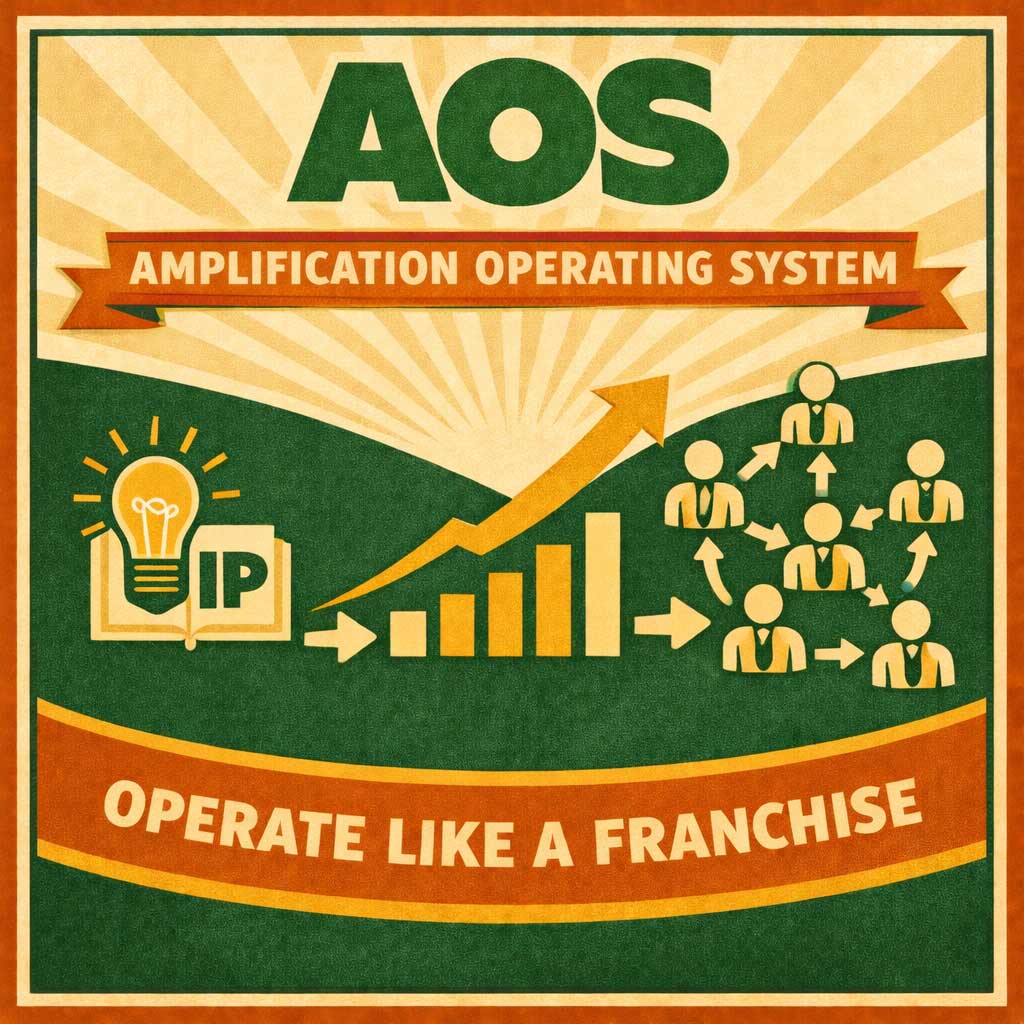
The system should carry the work.
In a traditional founder-dependent network, questions travel upward.
Every exception returns to the founder.
Every interpretation returns to the founder.
Every important client returns to the founder.
Every uncertain advisor returns to the founder.
The network grows.
The founder remains the operating system.
A scalable model changes the path.
                     FOUNDER
                        │
                        ▼
               PROVEN METHODOLOGY
                        │
                        ▼
             ADVISOR OPERATING MODEL
                        │
       ┌────────────────┼────────────────┐
       ▼                ▼                ▼
    ADVISOR          ADVISOR          ADVISOR
       │                │                │
       ▼                ▼                ▼
    CLIENTS          CLIENTS          CLIENTS
The founder remains the steward of:
- Vision
- Methodology
- Brand
- Standards
- Leadership
- Partnerships
- Future direction
The founder should lead the system.
The founder should not be required inside every transaction of the system.
The operating model carries:
- Methodology
- Training
- Tools
- Sales enablement
- Delivery support
- Knowledge
- Technology
- Quality
- Reporting
- Reinforcement
- Community
- Governance
This does not make the founder less important.
It makes the founder important in a different way.
The founder moves from primary producer of value to architect and steward of a value-creating network.
Supported independence
Weak systems force a false choice.
Give advisors total freedom and accept inconsistency.
Or control every action and destroy the independence that attracted them.
A strong model creates a third path.
Supported independence.
The company protects the method.
The advisor owns the practice.
The client receives consistency without losing the value of professional judgment.
Standardize what protects the result
- Core methodology
- Client promise
- Brand standards
- Ethical boundaries
- Required data
- Outcome measures
- Essential service stages
- Quality expectations
- Approved claims
- Escalation requirements
Preserve what creates entrepreneurial value
- Personal style
- Local relationships
- Market approach
- Industry expertise
- Practice-building choices
- Communication style
- Professional judgment
- Optional tools
- Business-development strategy
Structure is not the enemy of independence.
Good structure makes responsible independence possible.
The goal is guidance without micromanagement.
Support without dependency.
Standards without sameness.
Freedom without chaos.
Advisor success is the outcome.
Most networks measure recruitment.
How many people joined?
How many completed training?
How many paid?
How many attended the launch?
These numbers may matter.
They do not prove the model works.
The advisor journey is longer.
Attract
    ↓
Qualify
    ↓
Select
    ↓
Prepare
    ↓
Certify
    ↓
Launch
    ↓
First Client
    ↓
Consistent Delivery
    ↓
Healthy Practice
    ↓
Network Leadership
At each stage, the model should define:
- What the advisor must do
- What the company provides
- What proves progress
- What commonly blocks success
- What data is captured
- What happens next
The company should measure:
- Advisor attraction
- Candidate quality
- Time to readiness
- Time to first qualified conversation
- Time to first proposal
- Time to first client
- Delivery consistency
- Client outcomes
- Practice revenue
- Advisor economics
- Retention
- Referral activity
- Network contribution
- Leadership development
Advisor count is activity.
Advisor success is the outcome.
Certification is a milestone.
A healthy practice is evidence.
Client value is the final standard.
A complete model must work for three parties.
The company.
The advisor.
The client.
All three must become stronger.
The Service Company
The company needs:
- Expanded reach
- New revenue
- New market access
- Reduced dependence on internal delivery
- Stronger methodology
- Better field intelligence
- Owned operating assets
- A more valuable business
The Independent Advisor
The advisor needs:
- A credible opportunity
- A proven methodology
- A trusted identity
- Faster path to market
- Useful technology
- Delivery confidence
- Community
- Support
- Attractive economics
- A practice worth building
The End Client
The client needs:
- An experienced professional
- A trusted method
- Clear deliverables
- Consistent standards
- Relevant judgment
- Responsible support
- Measurable progress
- A valuable result
If company value is weak, leadership stops investing.
If advisor opportunity is weak, capable professionals do not join or remain.
If client outcomes are weak, trust collapses.
The model is sustainable only when value flows in all three directions.
All three must win.
This is not only an economic requirement.
It is an ethical one.
Advisor opportunity must not become advisor exploitation.
Distributed growth can create meaningful entrepreneurial opportunity.
It can also transfer risk unfairly.
A weak model asks advisors to pay, recruit, sell, deliver, and absorb uncertainty while the company provides little more than a brand and content library.
A responsible model does not hide weak economics behind inspiration.
It does not sell unrealistic income claims.
It does not recruit into an unproven opportunity.
It does not treat advisors as disposable distribution.
It does not celebrate signups while ignoring activation.
It does not lower client standards to accelerate network growth.
It does not create unnecessary dependency on the parent company.
It does not use AI to impersonate professional expertise.
It does not promise scale before the model has earned the right to scale.
A responsible model:
- Evaluates transferability honestly
- Tests economics
- Defines ownership clearly
- Protects advisor independence
- Supports practice launch
- Measures client outcomes
- Builds quality into the system
- Learns from evidence
- Improves continuously
- Tells leadership when the model is not ready
Advisor-led growth should create opportunity.
Not merely distribute risk.
AI should amplify the advisor.
Trusted service work still depends on human qualities.
Judgment.
Context.
Relationships.
Experience.
Discernment.
Accountability.
Trust.
AI can strengthen those qualities.
It can make approved knowledge easier to find.
Prepare advisors for conversations.
Reinforce methodology.
Reduce administrative work.
Surface relevant cases.
Support next actions.
Identify stalled progress.
Reveal patterns across the network.
Improve consistency.
Help leaders see where support is needed.
Potential capabilities include:
Advisor Onboarding Guide
Keeps the right early actions visible and helps advisors reach readiness milestones.
Methodology Knowledge Assistant
Provides approved methods, tools, examples, and decision guidance in the flow of work.
Practice-Launch Guide
Supports positioning, referral conversations, discovery, proposals, and next actions.
Client Decision Support
Helps advisors evaluate situations while preserving professional judgment and appropriate escalation.
Network Insight Assistant
Identifies stalled advisors, successful behaviors, support needs, delivery patterns, and emerging leaders.
Quality and Standards Assistant
Reinforces approved language, required steps, current materials, and client-experience expectations.
But the sequence matters.
Do not begin by asking where AI can be inserted.
Begin with:
What outcome matters?
What does the advisor own?
What judgment must remain human?
What knowledge should be available?
What work creates friction?
What must be visible?
What should be measured?
Then use technology where it creates leverage.
Automate the burden. Amplify the judgment.
Technology should make the network more capable.
Not merely more automated.
Every engagement should make the model stronger.
A traditional service engagement creates revenue.
It may also create knowledge.
That knowledge is often trapped inside the people who performed the work.
An advisor-led model should turn experience into compounding intelligence.
Every advisor conversation can improve positioning.
Every proposal can improve sales enablement.
Every client engagement can improve the methodology.
Every exception can clarify a decision principle.
Every outcome can improve measurement.
Every question can strengthen the knowledge system.
Every successful advisor can help define what readiness looks like.
Every difficult case can improve support and escalation.
Every market can reveal new applications.
The company should emerge with stronger assets:
- Methodology architecture
- Advisor profiles
- Economic models
- Selection systems
- Certification paths
- Practice-launch playbooks
- Client-delivery standards
- Knowledge systems
- AI agent specifications
- Data models
- Scorecards
- Dashboards
- Network-learning processes
- Governance
- Leadership development
Scale should create more than revenue.
It should create a stronger operating asset.
The network should not only carry the methodology. It should help the methodology become better.
The company you can build next
Imagine a company where growth does not depend solely on the number of employees it can recruit.
Experienced advisors are building respected independent practices around a method the company proved.
They create relationships in markets the internal organization may never reach.
They win clients.
They deliver through a shared system.
They apply professional judgment inside clear standards.
They contribute cases, insight, and learning back to the network.
Clients receive consistent value.
Advisors build meaningful businesses.
The company earns revenue, expands reach, and strengthens its operating assets.
Leadership spends more time on:
- Vision
- Methodology
- Partnerships
- Innovation
- Advisor leadership
- Network intelligence
- Market opportunity
- Long-term value
The internal team remains important.
But it is no longer the only way the company creates capacity.
The company has more than one growth engine.
It can continue serving key clients directly.
It can continue employing strong professionals.
It can also enable independent advisors to carry the method into new relationships, sectors, and regions.
The result is not a looser company.
It is a better-designed one.
A company with clearer standards.
Stronger assets.
Distributed capability.
More entrepreneurial opportunity.
Greater resilience.
A wider path to market.
A model that can outlive any one person.
From expertise to institution
EXPERTISE
    ↓
METHODOLOGY
    ↓
ADVISOR OPERATING MODEL
    ↓
ADVISOR-LED GROWTH
    ↓
INSTITUTION
Expertise begins as personal insight.
It becomes a methodology when the company can explain and repeat it.
It becomes an operating model when the opportunity, people, systems, knowledge, technology, standards, and economics support it.
It becomes advisor-led growth when capable entrepreneurs carry it into the market through practices of their own.
It becomes an institution when it:
- Develops leaders
- Preserves knowledge
- Improves itself
- Creates opportunity
- Protects standards
- Produces outcomes
- Builds durable assets
- Continues beyond its original founders
The founder’s greatest work is not remaining indispensable.
It is building something others can carry forward.
The company’s greatest asset is not merely its ability to deliver work.
It is its ability to create capability in others.
This is multiplication.
Multiplication is leadership.
Leadership is not only vision.
It is not only decision-making.
It is not only influence.
It is not only responsibility.
One of the highest forms of leadership is multiplication.
Leaders multiply when they:
- Transfer knowledge
- Build capability
- Develop judgment
- Create ownership
- Open opportunity
- Produce new leaders
- Build systems that work without constant control
A founder does not become less significant by enabling advisors.
The founder becomes significant in a different way.
Instead of being the person every client needs, the founder becomes the architect of the system through which many advisors serve many clients.
Instead of personally carrying every relationship, the founder builds a brand and methodology others can represent.
Instead of answering every question, the founder creates principles and systems that improve decision quality across the network.
Instead of remaining the hero of every story, the founder creates opportunities for new entrepreneurs to build stories of their own.
Not maintaining dependence.
Creating capability.
Not collecting followers.
Creating builders.
Not protecting personal importance.
Building something durable.
The founder leads the system. The system carries the work.
The principles of advisor-led growth
1. Proven expertise deserves to travel.
A methodology that creates meaningful results should not remain limited to one company’s internal delivery capacity.
2. The Delivery Trap is a model problem.
The problem is not that the team is failing.
The current growth equation has reached its natural limit.
3. Efficiency and multiplication are different.
Efficiency improves the existing engine.
Multiplication builds another path for value to reach the market.
4. Hiring is not the only way to grow.
Strong employees matter.
The company should not be limited to a single capacity model.
5. An advisor list is not an advisor business.
Recruitment creates names.
A complete operating model creates capability.
6. Advisor success must be designed.
Readiness, launch, first client, delivery, economics, and long-term growth should not depend on luck.
7. Independent does not mean unsupported.
Advisors need autonomy, ownership, standards, tools, support, and community.
8. Standardize what protects the result.
Preserve the judgment and individuality that make experienced advisors valuable.
9. All three parties must win.
Company value, advisor opportunity, and client outcomes must remain aligned.
10. Client outcomes are the final standard.
The network exists to create meaningful and consistent value for clients.
11. Technology belongs inside the model.
AI and automation should amplify a well-designed system, not replace the work of designing one.
12. Every engagement should strengthen the asset.
Knowledge, data, cases, tools, and insight should compound across the network.
13. Scale responsibly.
Do not recruit faster than the model can support.
Do not promise what the economics cannot sustain.
14. Multiplication is leadership.
The highest expression of proven expertise is enabling more capable people to create the result.
15. Build what can outlive you.
The destination is not only growth.
It is a durable institution.
What we reject
We reject the assumption that every new client must create another internal delivery obligation.
We reject growth strategies that depend only on adding headcount.
We reject the idea that a larger company is automatically a more scalable company.
We reject passive licensing disguised as an advisor opportunity.
We reject recruiting before designing the model.
We reject certification without practice readiness.
We reject training without a path to clients.
We reject economics that work for the company while failing the advisor.
We reject network growth that weakens the client experience.
We reject technology that automates confusion.
We reject AI that pretends to replace human judgment.
We reject systems that create dependence on consultants who built them.
We reject advisor count as the primary evidence of success.
We reject the belief that the founder must remain inside everything important.
We reject growth that makes the company heavier without making it stronger.
What we believe
We believe a proven service business can scale differently.
We believe the first growth engine can become the foundation for a second.
We believe proven expertise can become transferable.
We believe experienced professionals deserve credible paths to business ownership.
We believe independent advisors can become one of the most powerful forms of trusted service distribution.
We believe advisors need more than a brand, course, contract, or compensation plan.
They need a complete operating model.
We believe the Advisor Operating Model defines the business.
We believe the Advisor Operating System makes it work.
We believe company value, advisor opportunity, and client outcomes must strengthen together.
We believe the methodology should become better as more capable people carry it.
We believe AI should amplify trusted human expertise.
We believe systems create responsible freedom.
We believe ownership creates commitment.
We believe scale should create assets, not only revenue.
We believe multiplication is leadership.
We believe the next generation of service businesses will grow through a combination of employees, technology, and independent entrepreneurs.
We believe your expertise should travel farther than your internal organization can carry it alone.
The crossroads
Every proven service business eventually faces a choice.
Remain on the familiar path
Continue growing through:
- More internal delivery
- More employees
- More managers
- More oversight
- More fixed cost
- More complexity
- More pressure on senior expertise
This path can remain successful.
But the delivery ceiling remains attached to the size and capacity of the internal organization.
Build the second growth engine
Transform proven expertise into:
- A transferable methodology
- A compelling advisor opportunity
- Aligned economics
- Responsible selection
- Demonstrated readiness
- Practice-launch support
- Consistent client delivery
- A complete operating system
- Distributed market reach
- Compounding network intelligence
This path requires design.
It requires evidence.
It requires honest economics.
It requires patience.
It requires leadership.
Not every service is ready.
Not every market fits.
Not every methodology is transferable.
Not every founder should build an advisor-led model.
The right question is not:
How quickly can we recruit advisors?
The right question is:
What must become true for capable advisors, the company, and clients to succeed together?
That is the work.
Start with evidence.
Do not begin with a platform.
Do not begin with a legal agreement.
Do not begin with a recruitment campaign.
Do not begin with a certification program.
Do not begin with an AI tool.
Begin with the business.
What has the company proven?
What outcome does it create?
What part of the method is repeatable?
Where does judgment matter?
Who could credibly carry it?
What practice could they build?
Why would clients trust them?
How would the economics work?
What support would they need?
What must remain standardized?
What can remain adaptable?
What assumptions could break the opportunity?
What is the smallest responsible test?
The goal is not to justify the idea.
The goal is to make the next decision with evidence and confidence.
Some companies should proceed.
Some should validate one or two critical assumptions.
Some should wait and strengthen the method, market, economics, or organization.
Clarity is progress.
A wait decision can protect years of wasted investment.
A validation decision can reveal the truth before a large build.
A proceed decision can create the foundation for a new growth engine.
Scale differently.
You have already built something worth multiplying.
You created the service.
You earned trust.
You developed the judgment.
You produced the outcomes.
You built the reputation.
You proved the demand.
The next chapter is not simply delivering more work.
It is designing a model through which more capable entrepreneurs can deliver what you have proven.
Do not add capacity to the same model forever.
Build a model that multiplies capability.
Do not measure growth only by the size of the internal organization.
Measure how far the methodology can travel.
Do not ask only how many employees the company can hire.
Ask how many entrepreneurs the company can enable.
Do not build a network of names.
Build a system of successful practices.
Do not automate confusion.
Design the model, then use technology to make it stronger.
Do not create growth that one party must subsidize.
Build a model in which the company, advisor, and client all win.
Do not let every new sale become another obligation the internal organization must absorb.
Escape The Delivery Trap.
Build the second growth engine.
The invitation
Thirty Five helps proven service businesses determine whether advisor-led growth can become their next growth engine.
We help leadership evaluate:
- Method transferability
- Advisor opportunity
- Market trust
- Advisor and company economics
- Selection
- Readiness
- Practice launch
- Client delivery
- Quality
- Technology
- AI
- Network measurement
- Founding-cohort design
The starting point is the Advisor-Led Growth Readiness Sprint.
In ten business days, Thirty Five helps determine:
- What is already proven
- What is ready to multiply
- What must be designed
- Which assumptions need evidence
- What risks could break the model
- Whether to proceed, validate, or wait
- The smallest responsible next step
No generic strategy deck.
No predetermined answer.
No obligation to continue.
The goal is decision clarity.
Explore the Advisor-Led Growth Readiness Sprint
The final declaration
We are not here to help service businesses become endlessly heavier.
We are here to help proven expertise travel farther.
We are here to challenge the belief that every new client must require another internal hire.
We are here to build a different growth equation.
One that combines proven methodology, independent ownership, responsible standards, technology, and a complete operating system.
One that creates new revenue for the company.
A meaningful business for the advisor.
A trusted result for the client.
One that develops more entrepreneurs.
More leaders.
More capability.
More opportunity.
One that makes the company stronger as more people carry its work forward.
The future of service growth is not only bigger teams.
It is better models.
Scale differently.
Build the method.
Build the opportunity.
Build the model.
Build the advisors.
Build the system.
Build the second growth engine.
Built by Thirty Five
Thirty Five helps proven service businesses scale differently through independent advisors.
We turn proven methodologies into Advisor Operating Models that independent advisors can sell, deliver, and grow through practices of their own.